Monday, May 23, 2022

Greek Singer Stamatis Kokotas Testifies to a Miracle of Saint Eumenios He Witnessed


On December 12, 1996, on the Greek television show Zougla, hosted by journalist Makis Triantafyllopoulos, one of the most famous Greek singers of the 1960's and 1970's was a guest, Stamatis Kokotas. The program had to do with miracles, and the singer, who considered himself a skeptic unless he saw something with his own eyes, testified regarding a miracle he witnessed when he met Saint Eumenios Saridakis.
 
The singer was at the Hospital for Infectious Diseases in North Attica, where Saint Eumenios lived and served as a priest at the time, in order to visit someone he knew in the hospital. As he was walking by the rooms, he recalls seeing a priest with another patient. As he was walking and talking with someone, he suddenly heard a commotion coming from another room, where he went to find that people were crying. When he asked what had happened, he was informed that a girl who was a patient was near death and would not survive the night.

Tuesday, May 10, 2022

The Use and Overuse of the Word "Narrative" (Metr. Hierotheos of Nafpaktos)


By Metropolitan Hierotheos of Nafpaktos and Agiou Vlasiou

I often hear journalists and politicians use the word "his narrative" or "her narrative" in oral and written speech. At first I felt dissatisfied with the misuse of the word. It's certainly a good word, but its abuse in combination with the substitution of other words made me uncomfortable.

Let me quote some phrases that I highlighted which I came across that were either spoken orally or presented in writing: "The government narrative", "the dominant narrative", "his wife ... is the voice of the narrative", "the narrative with which he politicized", "the historical narrative of our neighboring country", "our national narrative", "killing his narrative", "a new narrative about the relations between Greece and Northern Macedonia is inaugurated", etc. I also found the expression "the narrative of the narrative"!

Thursday, April 28, 2022

Deleted Resurrection Scene From the Movie "Jesus of Nazareth" (1977)


The award-winning director of 1977's Jesus of Nazareth, Franco Zeffirelli, decided to remove a scene of the Resurrection in which Jesus shows his wounds to the Apostle Thomas, even though it had been shot. Zeffirelli explained that it was cinematically impossible to capture this scene without losing its mystery, so he decided to leave it out, in order for the audience to imagine it as they wanted:

"I tried to shoot the scene of the Resurrection and there were these problems, which you do not know how to solve. It is a mystery. Our job can become very difficult when you go to shoot such scenes. In a photo it is different, but in the cinema, which shows you facts, you cannot create this mystery. I tried it several times," the director explained and added:

Tuesday, April 12, 2022

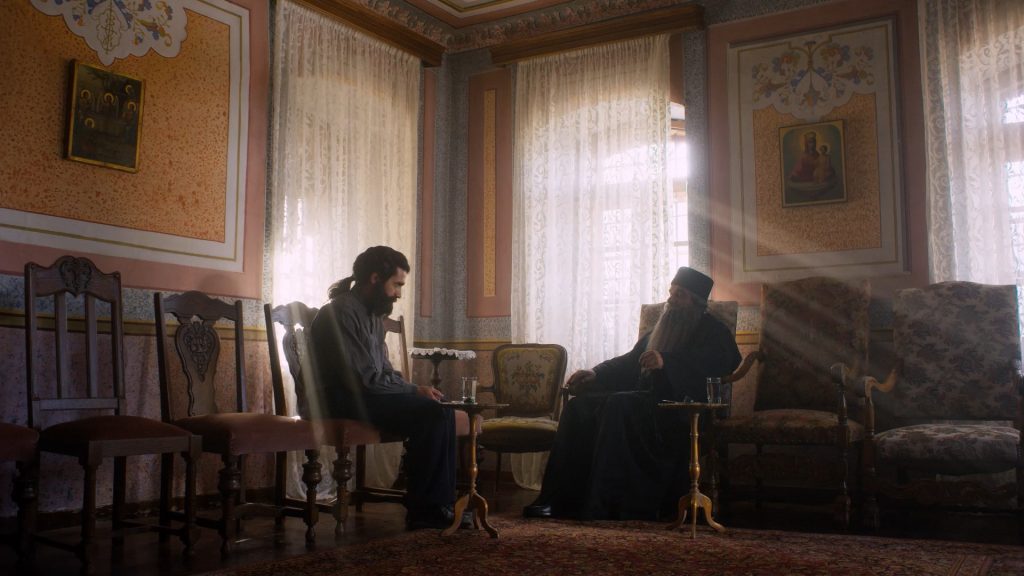
Greek Television Series on the Life of Saint Paisios (Episode 9)


Episode Nine (English subtitles)

Arsenios, following the advice of Elder Kyrillos, returns home to help his family cope with their daily struggles and make a dowry for his little sister, Christina. He lives in Konitsa and works hard for three years. Having fulfilled all the obligations towards his family, he leaves for Mount Athos for good.

He goes to the Holy Monastery of Esphigmenou, and under the guidance of Abbot Kallinikos the young novice follows the spiritual life. He is distinguished for his great zeal, his sacrificial love, his humility and the spirit of love he has for all his brothers. In fact, he patiently endures the cruel behavior of a cruel monk. Eventually, he became a lesser-schema monk and took the name Paisios. He says goodbye to his mother by sending her a photo of him and a poem, in which he describes his great desire for the spiritual life, to tell her that from now on his mother will be the Panagia.
 

Thursday, April 7, 2022

Greek Television Series on the Life of Saint Paisios (Episode 8)


...continued from episode seven.

Episode Eight (with English subtitles)

Arsenios, at great risk of his life, saves one of his soldiers who was wounded in battle. Everyone admires his courage and tries to understand how he was not hit by the many bullet shots he received in his attempt to transport the wounded soldier. Eulogia receives a great surprise. Arsenios returns home and tells her that he was released from the army. Her joy will not last long, because he announces that he will leave for Mount Athos. She begs him to stay for a while, but Arsenios leaves the next day.

His emotion is great when he enters the Garden of the Panagia. He turns to Father Kyrillos, a great spiritual father, who gives him the first advice on monasticism. Shortly afterwards, he receives a letter from his father asking him to return immediately to help him in the fields and to make a dowry for his little sister, Christina. Arsenios is in a big dilemma. He turns to Father Cyril again and asks for his advice.